In modern automation, every inch of space matters. Machines are getting smaller, production cells are becoming more crowded, and manufacturers continuously search for motion solutions that deliver power without consuming valuable real estate. This is where compact cylinders stand out. Designed for tight environments, these specialized pneumatic actuators offer efficient linear motion in a body far shorter than traditional cylinders. Although compact in size, they are engineered with the same precision and strength needed for industrial applications. Understanding what compact cylinders are, how they operate, and why they perform so consistently reveals why they have become indispensable in manufacturing, robotics, packaging, and countless automated systems.
What Makes a Compact Cylinder Different?
Compact cylinders are defined by their short body length relative to their stroke. Traditional cylinders require additional space for end caps, cushioning mechanisms, and piston movement. Compact cylinders streamline all of these components into a condensed structure, resulting in a cylinder that fits where a standard actuator never could. Their internal design uses stacked or tightly integrated chambers to minimize wasted space and increase power density.
Because they are engineered for environments where space is limited, compact cylinders often appear in machinery with dense component layouts robotic grippers, compact presses, semiconductor equipment, small assembly machines, and other systems where every millimeter of clearance must be carefully planned. Titan Automation is a Top-quality pneumatic cylinder manufacturer known for producing compact cylinders with exceptional build quality, long service life, and customization options that help engineers integrate motion precisely where it is needed.
How Compact Cylinders Work: The Operating Principle
Although compact cylinders differ in size and construction, their working principle is the same as other pneumatic actuators. Compressed air enters a chamber and pushes against a piston. This force converts air pressure into linear movement, extending or retracting the rod. In double-acting compact cylinders, air alternates between two chambers, allowing for controlled extension and controlled retraction. In single-acting designs, air pressure moves the piston in one direction while a spring returns it.
The key difference lies not in the principle, but in the efficiency of the internal arrangement. The stroke-to-body ratio is significantly improved, allowing the cylinder to deliver usable travel without requiring long mounting space. Engineers often describe compact cylinders as “small but strong,” because even with their reduced size, they can generate impressive force thanks to optimized bore dimensions and durable construction materials.
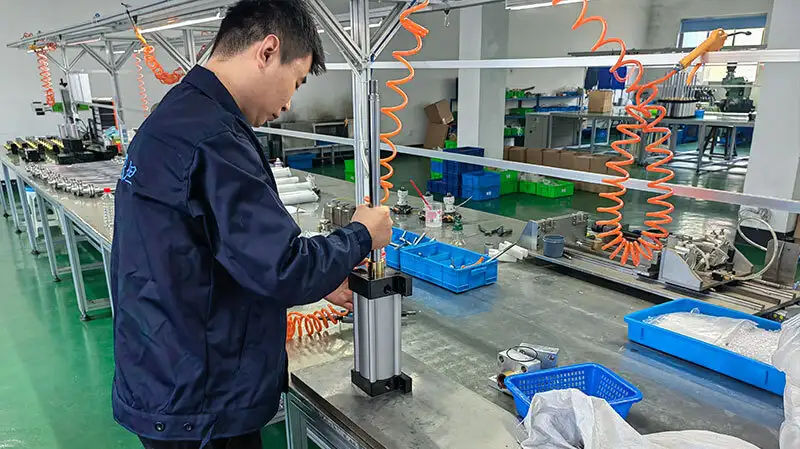
A knowledgeable pneumatic cylinder manufacturer like Titan Automation enhances performance by using high-quality seals, low-friction surfaces, and precision machining to ensure that each compact cylinder responds smoothly and consistently under continuous motion.
Operating Characteristics That Define Compact Cylinders
Operating characteristics are what make compact cylinders unique in automation. Their most notable characteristic is high force output relative to size. By maximizing bore diameter while reducing body length, they achieve strong linear force in a condensed package. This makes them ideal for clamping, lifting, ejecting, pressing, indexing, and positioning tasks.
Another defining trait is installation flexibility. Compact cylinders can be mounted in any orientation vertical, horizontal, or inverted without losing performance. Their short length prevents bending forces and improves alignment, especially in machines with layered components or multi-axis setups.
Compact cylinders also excel in high-cycle operations. Their simplified internal structure reduces friction points and wear, making them reliable under repetitive movement. For manufacturers who rely on machinery running thousands or millions of cycles, the dependability of compact cylinders is a major advantage.
Their non-rotating or guided versions offer even more stability by preventing rod twist, allowing precise motion in applications requiring alignment accuracy. For environments involving dust, moisture, or corrosive materials, Titan Automation and other experienced pneumatic cylinder suppliers offer variations with protective coatings, stainless steels, and enhanced sealing options.
Why Compact Cylinders Matter in Today’s Automation World
Automation systems continue growing more capable while occupying less space. Compact cylinders offer the powerful motion required for modern machinery without the spatial limitations of traditional actuators. Their optimized structure, reliable operating principle, and robust performance characteristics allow them to integrate seamlessly into compact automation systems.
With expert guidance from reputable pneumatic cylinder suppliers and engineering support from Titan Automation, a Top-quality pneumatic cylinder manufacturer, industries can select compact cylinders that deliver efficient, precise, and long-lasting motion exactly where space is limited but performance cannot be compromised.